
Types of betas
Bettas are broadly classified into “show bettas (improved varieties)” and “wild species (wild).
The “Show Betta” is the most widely distributed improved breed derived from the original “Betta splendens. Basically, the term “show betta” is used to refer to all improved breeds other than the traditional betta. In the past, only beautiful individuals in the contest class were called “Show Betta”.
veil tail

It is the least expensive, most vigorous, fertile, and easy-to-keep variety. It is also the most abundant in Thailand, where it is produced.
This is the best breed for beginners to keep bettas. It seems to have gotten its name from the shape of its tail fin.
Recently, the price has been rising slightly, and the market price is about $15 per fish. Most of them are primary colors, with white and emerald green tending to be a bit more expensive.
This is the most common betta, and you can find this variety in any tropical fish store. It is recommended that you start out with this variety as it is the best for an introductory breed. It is the most widely distributed variety, and can be found in any store that sells betta.
Double Tail
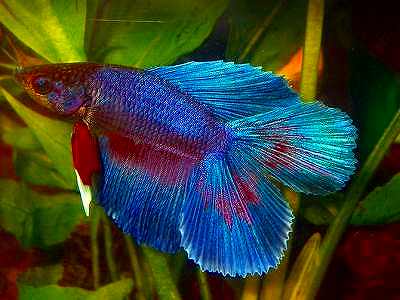
A variety with upper and lower tail fins. The smaller tail fin allows for faster swimming, and the fins are less prone to splitting.
Many of them have beautiful coloration and are tough, making them as easy to keep as veiltails.
The short body of this breed makes it difficult for males to mate, making it difficult to breed. The price is relatively low among bettas.
crown tail
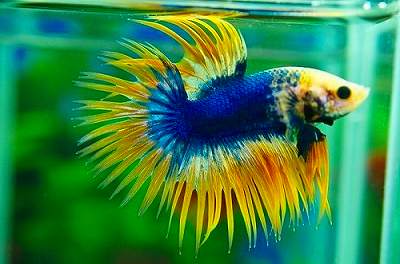
The fins of this variety are uniquely shaped and are called “crowntails” because the fins look like a crown, and there are several other names for this variety, depending on the shape of the fins and the way they are divided. (There are also intermediate individuals.)
Crown tails are mainly a combination of two color shades, and yellowish colors like the one in the image are quite rare.
It can be said that this variety is more beautiful when flared, and it is a slightly more expensive variety of betta. Individual differences in fins are quite large, and in general, the longer the fins, the better the breed looks.
comb's tail
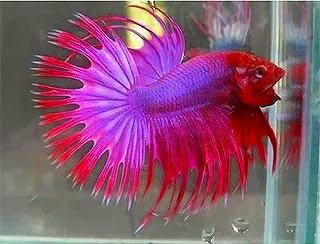
A subspecies of the clowntail with a comb-like spread of tail fins. While it is a major breed overseas, In Japan, it is often confused with the crown tail. The comb-tail itself is quite rare and is not widely distributed in Japan.
king tail
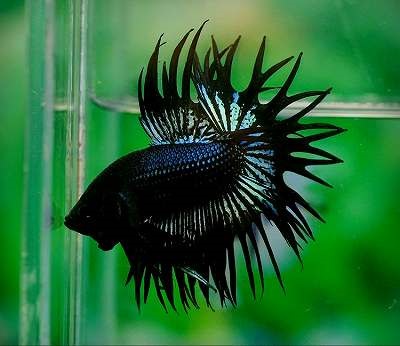
This is a variety derived from the crowntail, which differs from the regular crowntail in having a wide Y-shaped split at the tip of the tail fin. This king tail is also sometimes handled without much separation from the crown tail. Also, black bettas are rare and expensive.
half moon
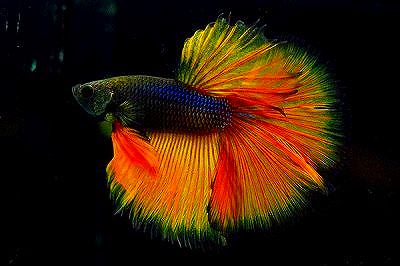
The “Half Moon” is the most beautiful of the many varieties, with tail fins that open to about 180 degrees when flared, and other fins that are also large. The Half Moon is very popular and is the most expensive of all bettas.
Although beautiful, the tail fins are very delicate and are especially prone to fin splitting under stress. The white type is particularly prone to this problem, and once a large tear occurs, it cannot be completely repaired. It is a breed for slightly more advanced breeders.
Individuals with tail fins that open more than 180 degrees are very rare and are called “over half moons” and are more expensive.
half-sun
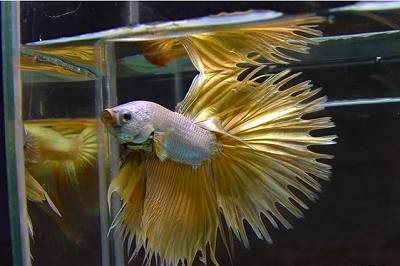
This betta was created by crossing a half moon with a crown tail betta and also with a double tail with a large dorsal fin. It is a blend of three different species, so it is difficult to produce good specimens when breeding, and there are only a few of them.
full moon
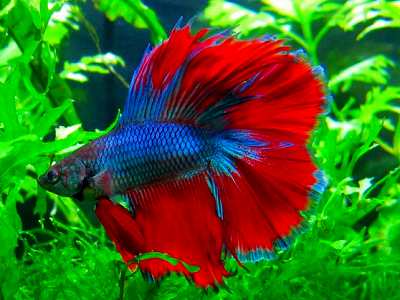
It is a subspecies of the double tail, with a larger and wider tail fin and a more “circular” silhouette than the “half circle” of the half moon. It is a variety that offers a silhouette closer to a “circle” than the “half moon's” half circle. It is quite a rare species, and its distribution in Japan is also small.
The figure is reminiscent of a full moon, and the beauty of the flaring is wonderful, although the price ranges depending on coloration and beauty. The fins are more difficult to avoid than those of half moons.
super delta tail
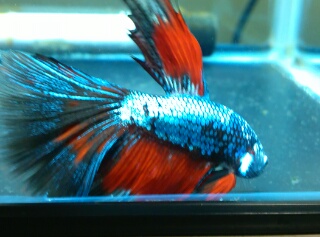
This variety has a triangular spread of tail fins and has a lower rating rank than the half moon.
It has a beauty similar to that of the half moon and is easy to keep because its fins do not split easily. It is also an easy-to-acquire breed because of its relatively low price and large distribution.
The triangular fins were divided into delta tails and the more triangular ones were divided into super deltas, Recently, however, they are becoming more unified.
Plakat
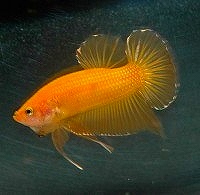
This variety is the closest in appearance to the original species, with shorter fins on each side. It is the fastest swimmer, and both males and females are similar in appearance. In Japan, it is commonly referred to as the “pragat,” and is considered to be the most temperamental of the species.
Recently, individuals with tail fins that open 90 degrees are also called “half-moon Plakat,” and the variation is expanding.
They are somewhat less popular and sell for relatively low prices. Many individuals have long life spans, but there have been many deaths due to ejection from the tank.
Incidentally, in Thailand, this variety is used in “betafighting,” in which bettas fight each other. In Thailand, this fish accounts for about 80% of betta production.
Giant Plakat
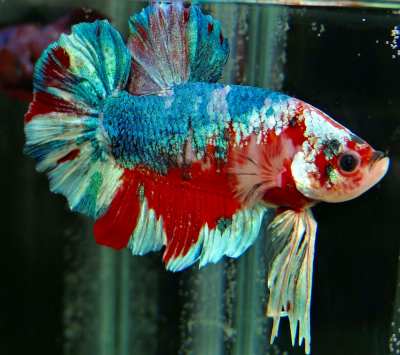
A mutation of the Placat variety, resulting in a larger size. This is a powerful betta with a body length of over 8 to 10 cm. The multi-colored multi-colored type shown in the image is inexpensive, but more beautiful monochromatic types have recently come into circulation. Single-colored individuals are more expensive, and the range of prices varies greatly depending on the coloration.
The Giant Plakat is a unique breed in terms of body thickness and shape. It is possible to keep the Giant Pracut by feeding it a little more food to increase its size. Because of its large size, the Giant Pracut often stays still and does not swim around.
half-moon plakat
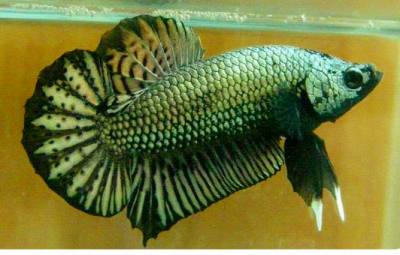
It is a relatively new variety with a semi-circular tail fin despite being a plakat. It is a relatively new breed. It has a wide variety of colors, and its small fins make it difficult to split. It is a beautiful and popular variety, although it is not widely distributed.
elephant ear
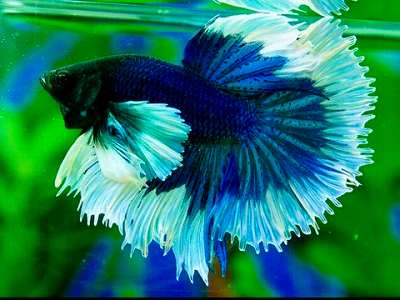
It is a variety with very large pectoral fins, which look like the ears of a statue, hence the name “elephant ear. The normally transparent pectoral fins are colored and are also called “dumbo” in Japan.
Crosses with other breeds are also made, and the individual in the image is an “Elephant Ear Half Moon”.
rose tail
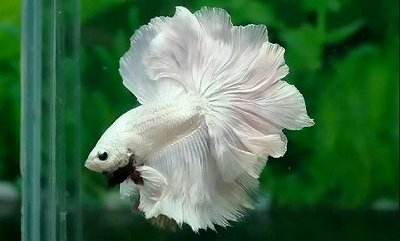
This is a variety derived further from the Half Moon, with tail fins that spread even wider and resemble petals. It is still in small supply in Japan and is very expensive. It is also called “Half Moon Konnock.
It is a beauty of the highest order, but the tail fins are very delicate and should be handled with care.
Koi colored betta
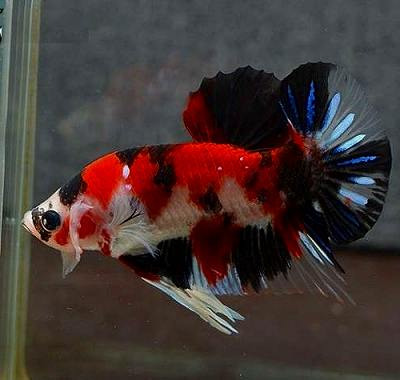
This variety looks like a koi carp with its body colors divided into red, white, and black. It is a relatively new breed, and the name is precisely for its body color. Other varieties of betta are also called “Koi colored betta” if they have this body color.
In addition to plakat, half moons with this kind of coloration are also distributed, and they are very popular in Japan.
The price is determined by the beauty of the coloring, so if it is as beautiful as this picture (the best top quality), it would be about 80$.
sea betta
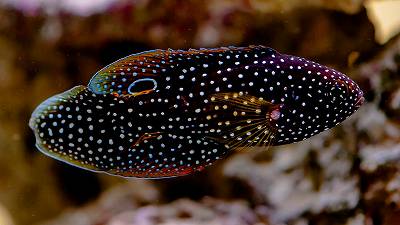
Extremely rare, this betta lives in saltwater rather than freshwater. Because it is a saltwater fish, it is difficult to keep in captivity, but in the wild it lives in schools. Although small and cute, it is considered a close relative of the Betta splendens group, which is different from the Betta splendens group.
wild betta
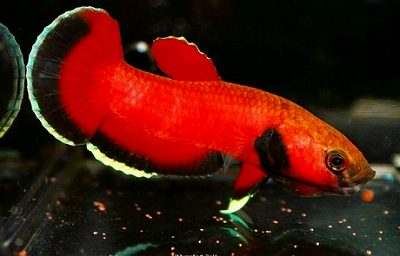
There are far more species of wild bettas than improved bettas, with more than 50 varieties found today alone.
Since this is a wild species of betta, it is difficult to keep and requires a large 3-gallon or larger aquarium and aeration. Since the main food is frozen red worms, keeping them is quite difficult, but they have the beauty of a wild species, so those interested may want to give it a try.
There is a wide variety of tail fin shapes, such as “round tail” and “spade tail,” and some varieties have characteristics completely different from those of ordinary bettas.
Also, unlike other improved varieties, bettas do not fight with each other as they are wild-environment fish, a characteristic that allows males and females to be kept in pairs in the same aquarium.
Betta macrostoma
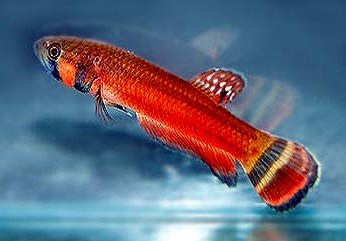
This is a species of wild betta. It is one of the most popular and rare species of betta. It is one of the largest species of betta, and unlike ordinary bettas, it is vulnerable to high water temperatures. Basically, it is difficult to live in water temperatures below 25°C (77°F) and requires an aquarium cooler in the summer.
The adult is about 11 cm long, also known as “Brunei Beauty. While it is large and beautiful, it may be the most difficult to keep. Even so, there are many domestic enthusiasts.
Some countries are restricting exports due to overfishing, and it may become more difficult to obtain this species in the future. It is also the most temperamental of all wild bettas.
rubra
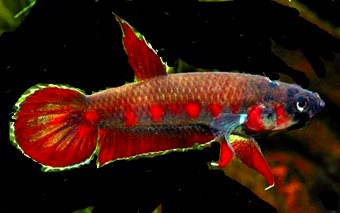
Long known as the “phantom betta” variety, this “red wild betta” was discovered nearly 100 years ago and not found until recently. It has a red spot from the fry stage and is still quite rare. It seems to be a close relative of Betta inveris, and it seems to be difficult to keep.
Patootie
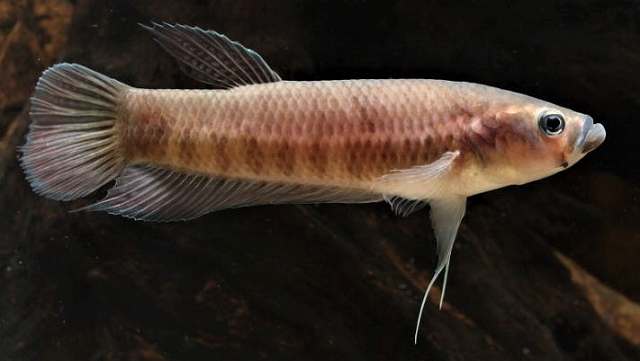
A large betta that grows up to about 10 cm in length. Individuals vary widely by region of origin, and most individuals are basically striped. They have the same habits as other wild bettas, but they are more friendly and curious. Breeding is difficult, and most wild-collected bettas are sold.
Tail of wild betta

Wild bettas have uniquely shaped tail fins. The first image shows the tail fin of a normal improved variety, Veiltail.
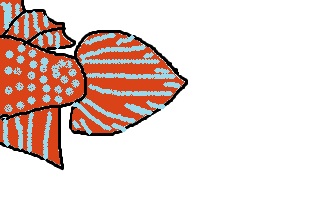
And wild bettas, spade tails found only in wild species. The spade shape is not seen in show bettas It is unique.
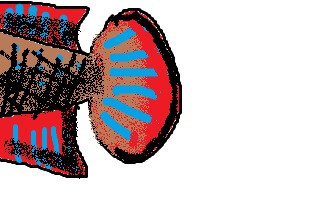
The “round tail” is also found in wild species and in the plakat of show bettas. It seems that they mutated from this to variously shaped tail fins.
Betta Colors
Betas are broadly divided according to the shape of their fins, but other betas are also named in detail according to their color.
Butterfly
This is the same image as the Elephant Ear, but if there is a white color on the edge of each fin, it is called a “Butterfly”. In the case of this individual, it would be something like “Blue Elephant Ear Half Moon Butterfly.
clear fin
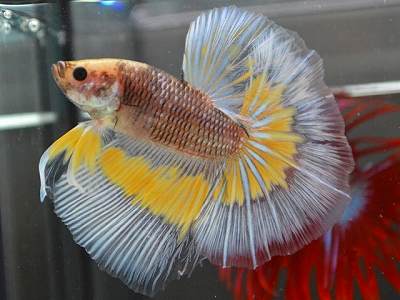
Individuals with transparent rims on each fin are called “clear fins. While very beautiful, transparent fins are the most delicate. The individual in the image is a “Clearfin Butterfly” because it also has white fins.
Copper, Dragon
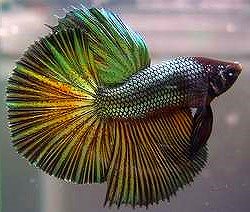
Individuals with shiny metal-like fins and scales are called “Copper,” while those whose scales are entirely silvery are called “Dragon,” and there is also a “Copper Dragon” that has both.
The metallic luster is very beautiful and stunning when seen in person. Because of its popularity, it is also very expensive. Lustrous white is called “platinum white” and is extremely expensive.
Pineapple
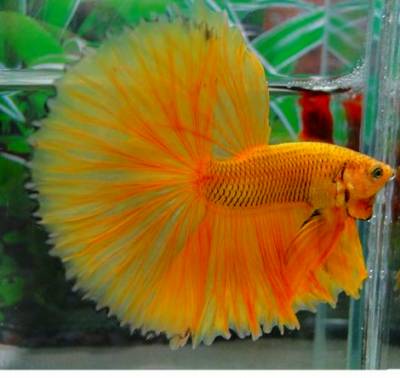
This variety is yellow with black lines on the betta scales. It has a beautiful appearance reminiscent of a pineapple. The darker the body color and the more solid the lines on the scales, the more expensive it is, while the lighter the color, the lower the price. The image is “Pineapple Yellow Half Moon”.
Marble
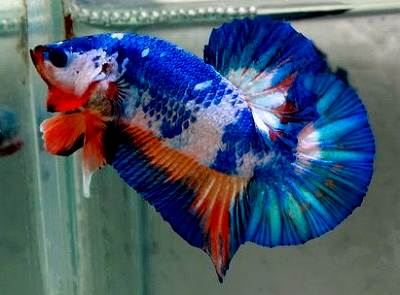
It is difficult to clearly define, but individuals with “marble-like” body coloration, with a marbled pattern. There are many variations of this coloration, and you can often find them in tropical fish stores. When three or more colors are applied, it is also called “fancy marble.
Solid
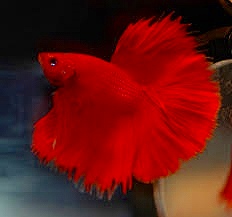
It means “monochromatic,” and as the name implies, the entire body is solid of only one color. However, strictly speaking, true monochromatic individuals are hard to find.
The highest grade of solid is the one shown in the image, which is matte and free of any other color.
Bi Color
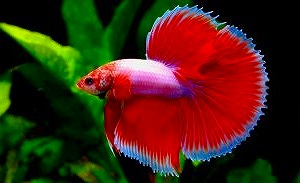
The coloration in which the body and fins are divided into two colors is called “bicolor. This is a fairly popular coloration, and it seems that this is also a familiar coloration in tropical fish stores.
Multi Color
Individuals with three or more main colors are called “multi-colored. There is a great deal of variation, with many individual differences, and it is not easy to find bettas with the same color pattern.
Triband
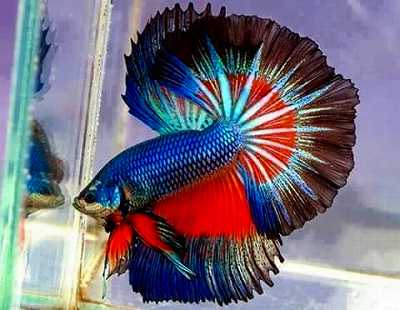
The same multi-colors are used, but the body and tail fins are each divided into three different colors, which is called a “tri-band. This is a very rare color. It is also a rare species that can only be found at betta specialty stores.
Pastel Colors
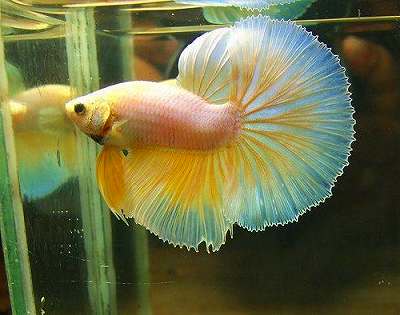
Individuals with light pink body color and fin coloration are called “Pastel Colors”. Frankly speaking, if this is spotted with other colors, it becomes “marbled,” and it is difficult to make a strict distinction.
There are also rare color individuals such as “Pastel Picasso,” which is a more transparent pastel with clear fins and multi-colored spots throughout.
Mustard gas
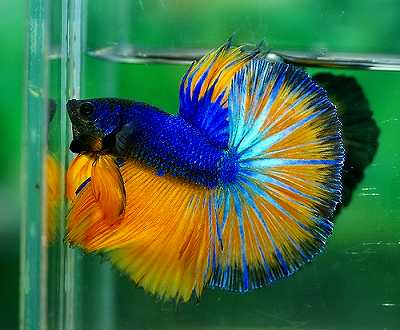
The “mustard gas” is a betta with a blue body color and yellow fins, a coloring unique to bettas and not seen in other freshwater fish. This coloration seems to be especially popular overseas.
Lavender
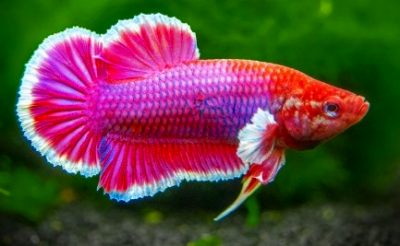
This variety has a pale rose pink body and fins. Even if only the fins are pink, it is classified as “lavender”. When individuals are in good condition, the body color becomes darker and more beautiful. The number of beautifully colored individuals is decreasing, The number of beautifully colored individuals is decreasing, and the amount of distribution in Japan is also small.
salamander
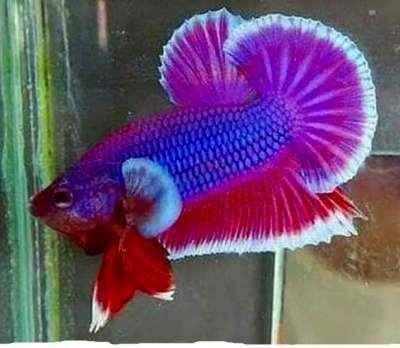
The color with blue body and different fins is called “salamander”. The fins are pinkish, so the individual in the image is a “Salamander Lavender Butterfly”.
Cambodian
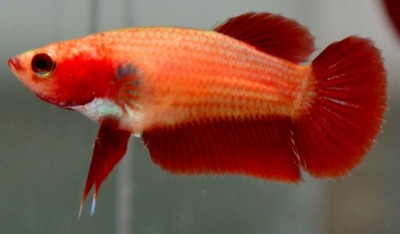
This variety has a pale pink body and only the fins are colored. It may be a fairly popular gene, often seen in stores and easily available. It is somewhat unpopular and can be purchased very inexpensively.
Dalmatian
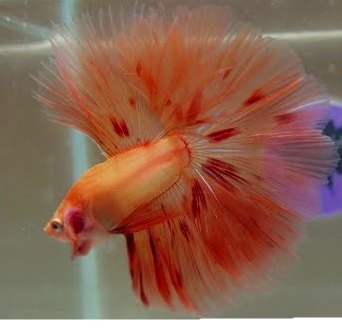
Basically, the body is uncolored or pale pink with small spots of a different color on the fins. A variety with spotted Cambodian fins. However, even if the body and fins have spots of the same color The Dalmatian is classified as a Dalmatian. Most of them are red, but there are also blue ones.
Peabard
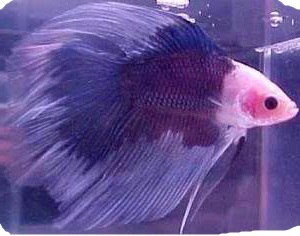
A variety in which only the head of the betta is not colored. It is also called “monkey face. It is not very popular and is in a minor category.
grizzle
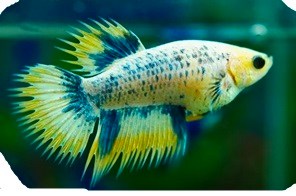
A variety with numerous spots on the scales. If the fins also have spots, they are more expensive. This is also less popular, but has its own uniqueness with no “same color”.
Albino
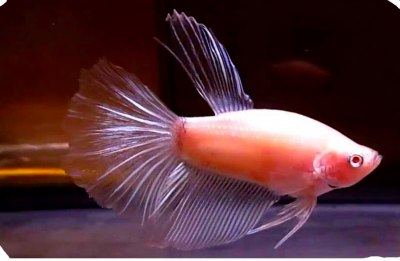
They are born without pigmentation, so their eyes are red and their bodies are light orange. The fins are transparent or pale white. This is an extremely rare specimen, but it is not highly regarded among bettas for which color is important.
The betta has an almost endless variety of colors, and although it is quite complicated, it may be useful to keep in mind if there is a variety that suits your tastes. Only this fish has a myriad of color variations. The world of bettas is truly a very deep one.
There are different types of betas' mouths.

Individual bettas also vary in the position of their mouths, or rather the type of mouth, and large-mouthed bettas often have their mouths slightly above the level of the betta's eyes.

Conversely, some bettas have their mouths almost as high as their eyes. The mouth is slightly smaller and is more common in females. Males of this type also exist, but they are not superior to each other in terms of ease of catching food.
There's a difference in the betas' eyes.
Although there are clear differences in the eyes of individual bettas, there is no official name for them. There is no official name for it, but it is just like saying, “There are individuals with this type of eyes. It may be good to find your favorite type.
normal eyes
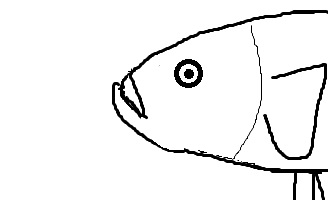
Like other fish, this type has separate white and black eyes. You can see the betta's eyeballs move as well. It is a very fish-like eye, but it is a type that is rare in bettas and gives them a charming look.
Black eye type
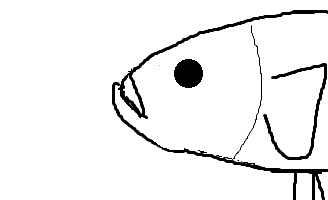
This type appears to have large black eyes. This type seems to be the most common type of betta. It is the most dignified and most male betta-like eye.
Eyelid type
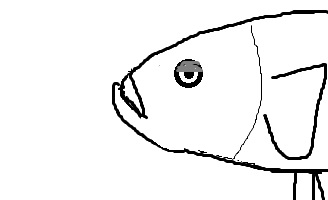
In addition to the black eye, this type has other colors in the whites of the eyes. It is characterized by the appearance of eyelids and is the second most common after the black eye. It is a cool eye when seen close-up.
Horizontal line type
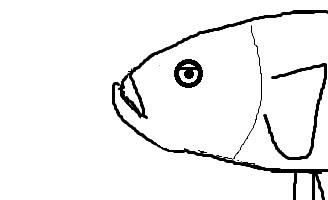
A type with horizontal lines across the eyes. Most common in female bettas, but sometimes seen in males as well. It gives the impression of a female's eye, but it also gives the impression of the eyes characteristic of bettas. but it also has the look of eyes peculiar to bettas.
Betta body shape
slim type

Each individual betta has a different body shape. Many people may find the slimmer the more beautiful. The smart body shape is often seen in veiltails and half moons. They also have a long body.
big-bodied

A type with a thick body, which is common in double-tailed and giant placats. The body is thicker than that of the double-tailed and giant plastic cutters, and many of them are proportionally shorter.
Show bettas are mainly farmed in Bangkok, Thailand, and new varieties are being produced daily by a very large number of breeders. It is possible that new species of bettas will emerge in the future, so we are looking forward to the future.